What is intermittent pneumatic compression?
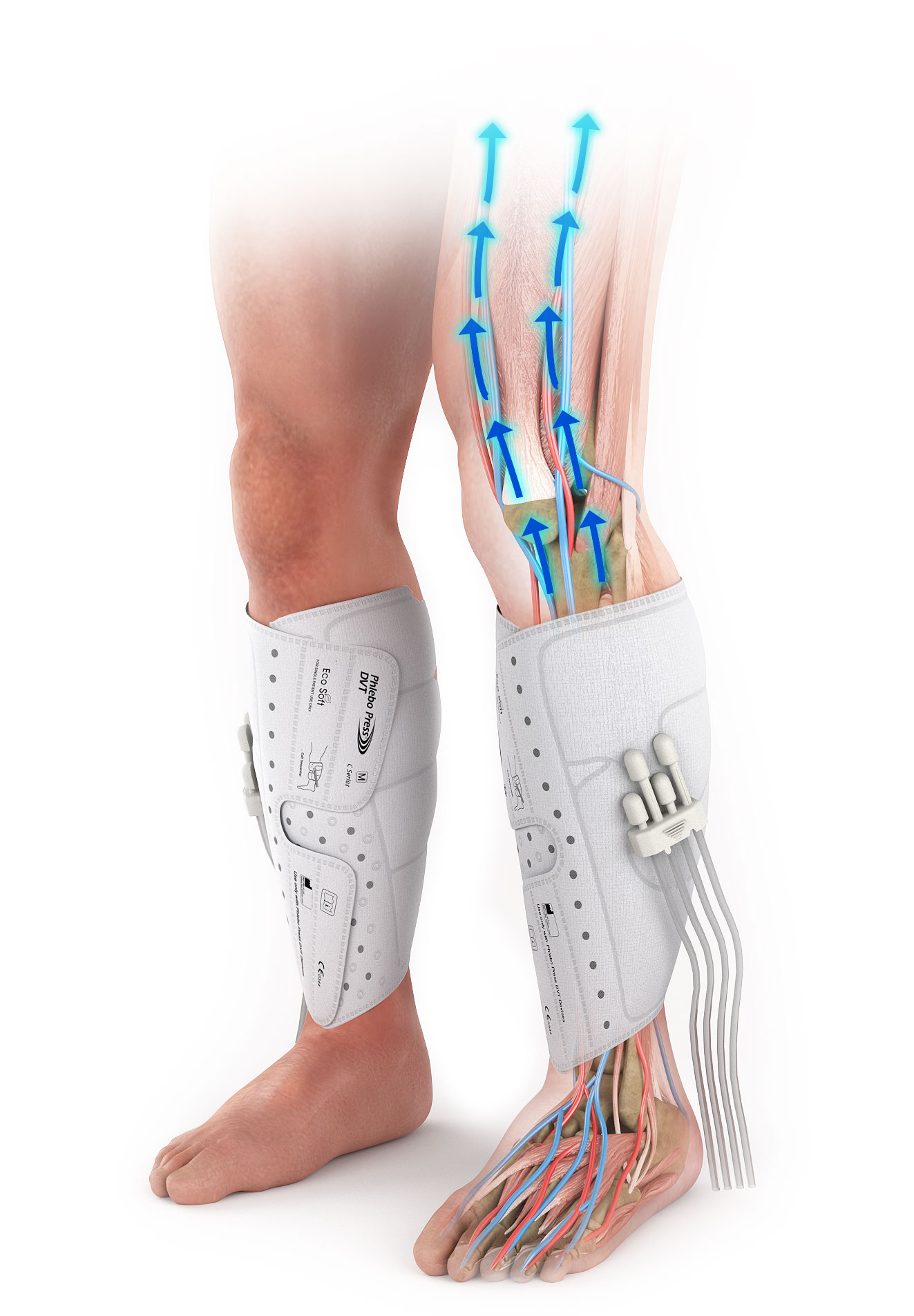
Intermittent pneumatic compression (IPC) — in German also apparative intermittierende Kompression (AIK) — is a mechanical method of thromboprophylaxis. A device fills compression garments on the leg with air pressure in fixed cycles and releases them again. This cyclic compression supports venous return from the legs to the heart and counteracts a stasis of blood in the deep veins — one of the central risk factors for venous thromboembolism (VTE).
The mode of action in detail
In IPC, compression garments on the leg are filled with air pressure in fixed cycles and released, typically about once per minute. This mechanism mimics the natural calf muscle pump, which is inactive in immobilised or bedridden patients. Three effects work together:
- Acceleration of venous return: the cyclic pressure pushes blood from the deep veins towards the heart and reduces stasis.
- Reduction of blood stasis: less standing blood means a lower risk of clot formation in the leg veins.
- Promotion of fibrinolysis: mechanical stimulation is associated with an increase in the body's own fibrinolytic (clot-dissolving) activity.
Unlike pharmacological prophylaxis, IPC does not interfere with blood coagulation. This makes it an important option when medication is not an option — and a sensible addition in high-risk settings.
IPC, AIK, pneumatic compression — the terms
Several common designations exist for the same procedure, which occasionally causes confusion in the ward routine and in guidelines:
- IPC — intermittent pneumatic compression (German: IPK).
- AIK — apparative intermittierende Kompression, the term of the German S1 guideline (AWMF 037-007).
- Pneumatic compression / apparative compression therapy — common short forms.
All mean the same: device-supported, cyclic compression of the limb. IPC/AIK is to be distinguished from the medical thromboprophylaxis stocking, which applies a static, continuous pressure.
Sequential or intermittent?
Compression garments come in two modes of operation, used according to the order of the treating professionals:
| Feature | Sequential | Intermittent (single-chamber) |
|---|---|---|
| Chambers | several (e.g. 4) | one |
| Filling | one after another, distal → proximal | even |
| Pressure profile | graduated gradient (e.g. 45, 42, 39, 36 mmHg) | uniform pressure |
| Effect | directed "wringing" of blood towards the body | rhythmic compression |
The Phlebo Press® DVT 603 detects the connected garment type automatically and selects pressure and sequence accordingly.
Areas of use
IPC is used in the hospital as a mechanical measure of thromboprophylaxis — as the sole measure when medication is contraindicated, or as an addition in high-risk settings. The indication is determined by the treating professionals. Typical areas of use and specialty-specific context:
- Orthopaedics & joint replacement — high-risk procedures such as hip and knee replacement
- Intensive care — immobilised and ventilated patients
- Gynaecology & obstetrics — surgery, caesarean section, oncological operations
- Vascular surgery — where there is a particular bleeding risk
Distinction & contraindications
IPC is not suitable in every situation. Recognised contraindications include known or suspected acute deep vein thrombosis, severe cardiac failure and advanced peripheral arterial occlusive disease. Details on the page on IPC contraindications. How IPC relates to pharmacological prophylaxis is explained under mechanical vs. pharmacological thromboprophylaxis.
Framing & evidence
Mechanical thromboprophylaxis by means of IPC is anchored in the S3 guideline on VTE prophylaxis (AWMF 003-001); a separate S1 guideline (AWMF 037-007) addresses apparative intermittent compression in detail. Systematic reviews show a significant reduction in VTE risk from IPC compared with no prophylaxis. We give an overview of the body of studies in the section Studies & evidence.
IPC devices from UniCare
UniCare supplies the IPC systems of the Phlebo Press® technology with German service: the mobile Phlebo Press® DVT 650 Easy for standard use on the leg and the Phlebo Press® DVT 603 as an all-in-one system for leg and foot indications. Both CE-compliant under MDR, with device instruction under §83 MPBetreibV and guaranteed availability from the warehouse in Hesse.
Frequently asked questions
What is intermittent pneumatic compression (IPC)?
IPC is a mechanical method of thromboprophylaxis. Inflatable compression garments on the calf and/or thigh are cyclically pressurised and released by the device. This promotes venous return and supports blood flow in the deep leg veins. In German clinical usage the method is also called apparative intermittierende Kompression (AIK).
What does the abbreviation IPC (IPK / AIK) mean?
IPC stands for "intermittent pneumatic compression" (German: IPK, intermittierende pneumatische Kompression). AIK stands for "apparative intermittierende Kompression", the term used by the German S1 guideline (AWMF 037-007). All refer to the same procedure: device-supported, cyclic compression of the limb to promote venous return.
How does IPC differ from pharmacological prophylaxis?
IPC works purely mechanically, without affecting blood coagulation. It is therefore an option in particular when pharmacological prophylaxis is contraindicated — or as an addition in high-risk settings.
What is the difference between sequential and intermittent garments?
Sequential garments contain several air chambers that fill one after another from distal to proximal in a graduated pressure gradient, moving the blood in a directed way towards the body. Intermittent garments have a single chamber that fills and releases evenly. Both are used according to the order of the treating professionals.
When is IPC contraindicated?
Among others, in known or suspected acute deep vein thrombosis, severe cardiac failure and advanced peripheral arterial occlusive disease. The assessment of indication and contraindication is made by the treating professionals. A compact overview is on our page on IPC contraindications.
Which device does UniCare use?
The Phlebo Press® DVT 650 Easy and the Phlebo Press® DVT 603 — mobile IPC compression devices with automatic pressure control, quiet operation and CE conformity under the MDR. The 603 additionally detects leg and foot garments automatically and works with two pressure ranges (45/130 mmHg).